
73 Strings
PROJECT INFO
- CLIENT: 73 Strings
- DATE RELEASED: 2025 - 2026
- MY ROLE: Senior UX Designer
- TAGS: fintech, AI assistant, private assets, product design, SaaS, B2B, fintech API, productivity tools
Overview
73 Strings is an innovative platform providing comprehensive data extraction, monitoring, and valuation solutions for the private capital industry. The company’s AI-powered platform streamlines middle-office processes for alternative investments, enabling seamless data structuring and standardization, monitoring, and fair value estimation at the click of a button. 73 Strings serves clients globally across various strategies, including Private Equity, Growth Equity, Venture Capital, Infrastructure and Private Credit.
My Role
As Senior UX Designer I worked on enhancing the user experience of an existing, data-heavy enterprise product, focusing on complex workflows such as valuation creation, multi-layer waterfall analysis, document extraction (PDF/Excel), monitoring, and AI-assisted valuation flows. A key part of my work involved designing experiences for an agentic AI assistant, shaping human-in-the-loop interactions where AI guides users through complex tasks while keeping decision-making transparent and under user control.
The work was carried out in a true enterprise environment with complex business rules, large data tables, multiple user roles, and close collaboration with Product, Engineering, CSM, Implementation teams, and senior leadership.
PROJECTS
Case Study 1: AI Assistant for Valuation Creation
Objective
Design complex, agent-led workflow with human-in-the-loop control.
Problem
Creating a valuation is a complex, multi-step process involving method selection, financial inputs, assumptions, and validation. The existing UI-heavy flow required many clicks and assumed deep system knowledge. The challenge was to introduce an AI assistant that could guide users through this complexity without removing control or trust.
Discovery
Establishing Human-in-the-Loop Principles
Before designing screens, I defined core UX principles for Human-in-the-Loop AI, ensuring:
- AI suggestions are transparent and explainable
- Users explicitly confirm key decisions
- Automation never silently overrides user input
- Errors, missing data, and uncertainty are clearly surfaced
This ensured the assistant would augment expert judgement rather than replace it.
I created user journey workflow where the assistant:
- Guides users step by step through valuation creation
- Asks contextual questions only when required
- Surfaces relevant UI panels for structured input
- Validates inputs before allowing progression
The orchestration layer connects conversational intent to structured valuation configuration, ensuring that:
- User intent translates clearly into system state
- Dependencies are respected
- Incomplete inputs are flagged before execution
- Users retain full control over final submission
Defining Step-Level Design Approach
I created user journey workflow where the assistant:
- Guides users step by step through valuation creation
- Asks contextual questions only when required
- Surfaces relevant UI panels for structured input
- Validates inputs before allowing progression
The orchestration layer connects conversational intent to structured valuation configuration, ensuring that:
- User intent translates clearly into system state
- Dependencies are respected
- Incomplete inputs are flagged before execution
- Users retain full control over final submissio
Create valuation workflow diagram
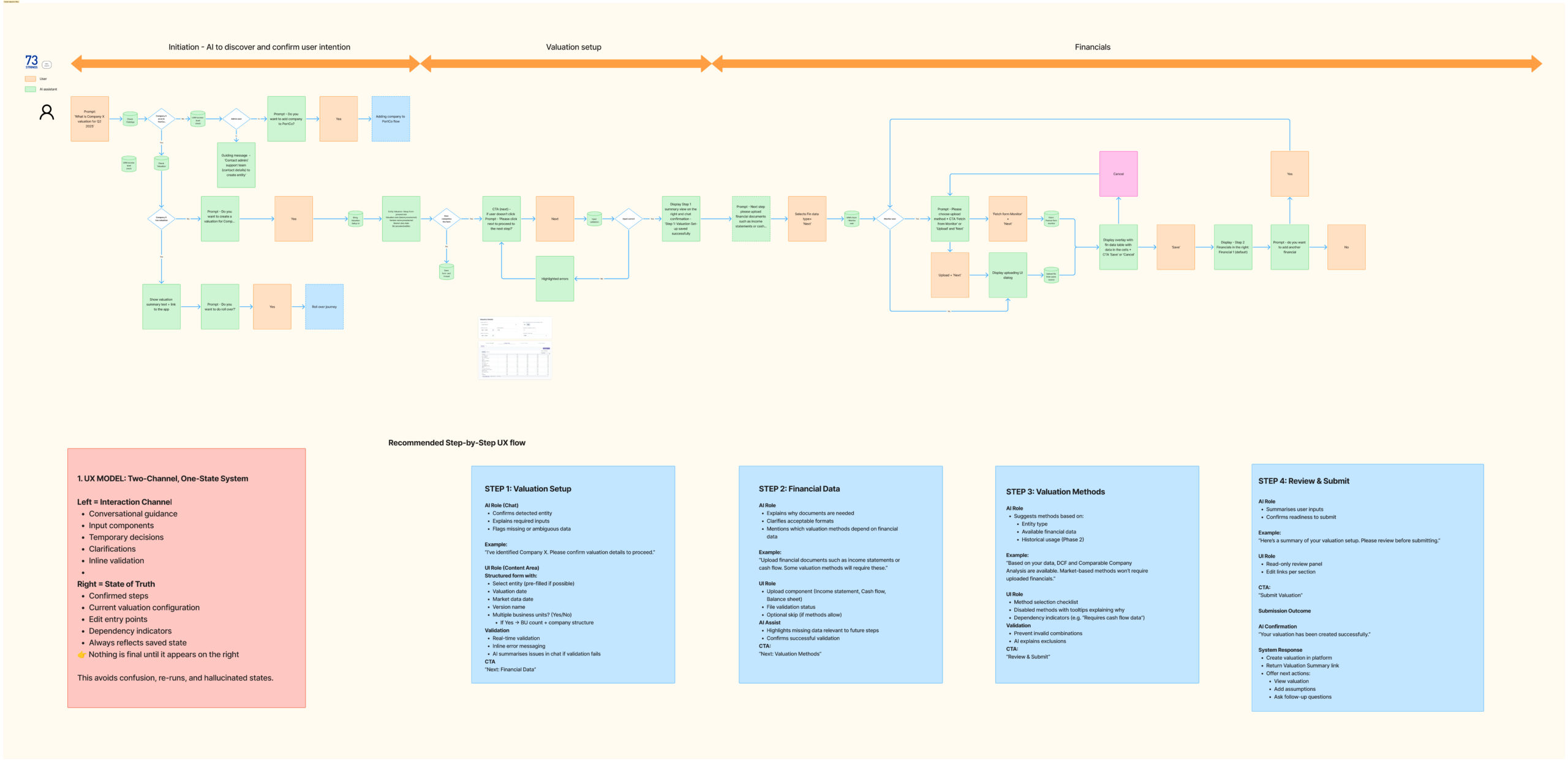
For each step in the valuation flow, I defined a structured design framework:
- AI Role — What the assistant is responsible for (guidance, questioning, suggestion).
- UI Role — What the structured interface displays and controls.
- Validation — What must be confirmed before progressing.
- CTA Logic — What actions are enabled, disabled, or gated.
This framework ensured consistency across steps and reduced ambiguity between conversational and structured interaction.
Ideation and Prototyping
Defining the AI UX Interaction Model
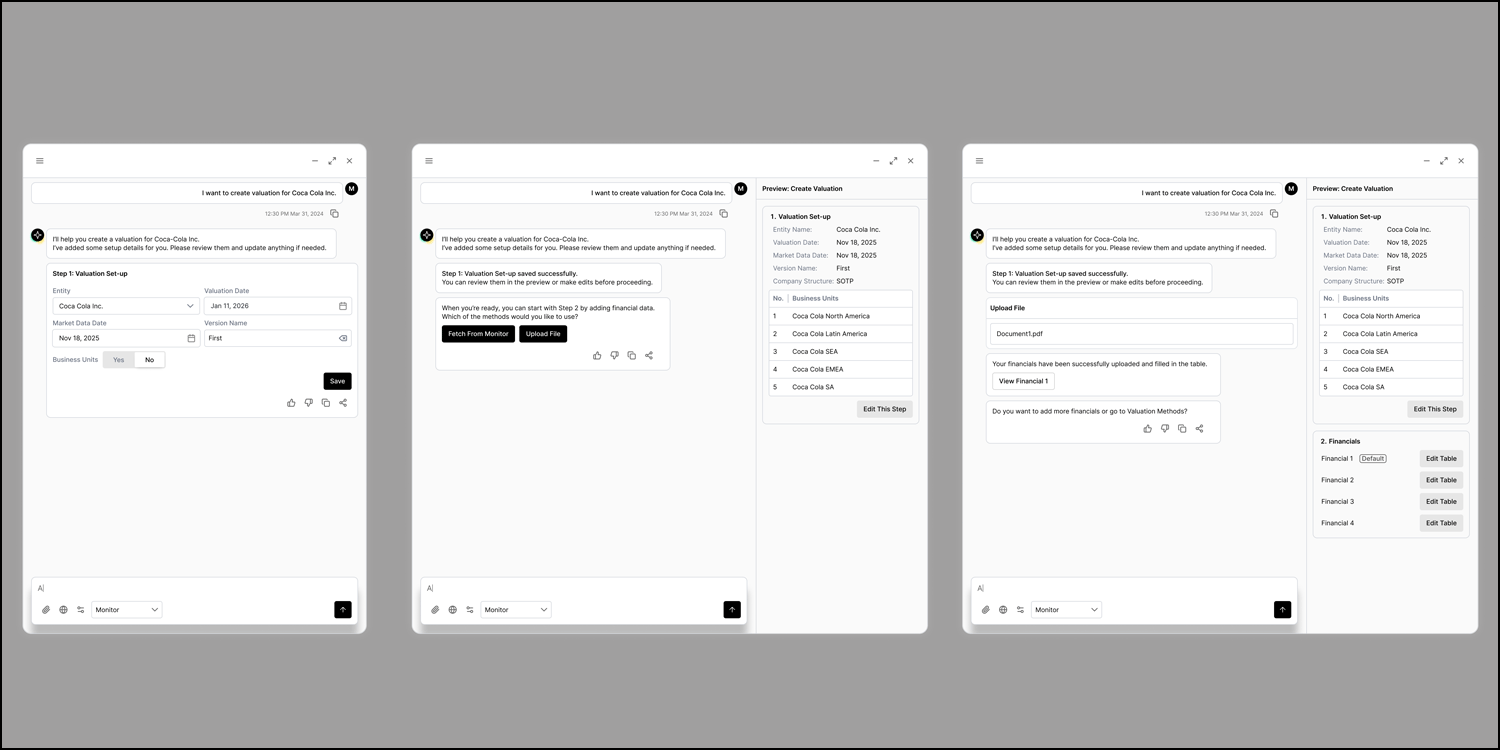
I created a user journey workflow model that split the interface into two coordinated channels:
Interaction Channel (Left Panel)
Focused on dynamic AI-led interaction:
- Conversational guidance
- Input components
- Temporary decisions
- Clarifications
- Inline validation
This channel supports exploration, iteration, and AI-led questioning.
State of Truth Channel (Right Panel)
Focused on stability and confirmation:
- Confirmed steps
- Current valuation configuration
- Edit entry points
- Dependency indicators
- Always reflects saved state
This structure ensured users always had a clear, persistent view of what was officially configured versus what was still in progress.
Create valuation AI workflow
Impact
Early prototype testing validated that the direction taken for integrating complex workflows into an AI assistant was sound. Users were able to follow the conversational guidance while maintaining clarity over system state and confirmed configurations — reinforcing that the dual-channel interaction model was intuitive and trustworthy.
Importantly, this initiative operates in largely uncharted territory. There are currently no established enterprise examples of deeply integrated, agentic AI orchestrating multi-step financial valuation workflows at this level of complexity. Unlike generic AI copilots, this required designing new interaction patterns from first principles.
Case Study 2: Multi-layer Waterfall & Valuation Workflows
Objective
Simplifying complex financial hierarchies and calculations
Problem
The Multi-layer Waterfall redesign was not only about improving an existing calculation workflow — it was about aligning the waterfall logic with a newly introduced Entity Management System (EMS).
The EMS introduced a structured and more complex hierarchy of investment relationships between entities, including operating companies, funds, funds of funds, General Partners (GPs), and Limited Partners (LPs). This created a challenge: the existing waterfall experience was designed around simpler, flatter structures and did not fully reflect or support the cascading parent–child relationships defined in the EMS.
Discovery
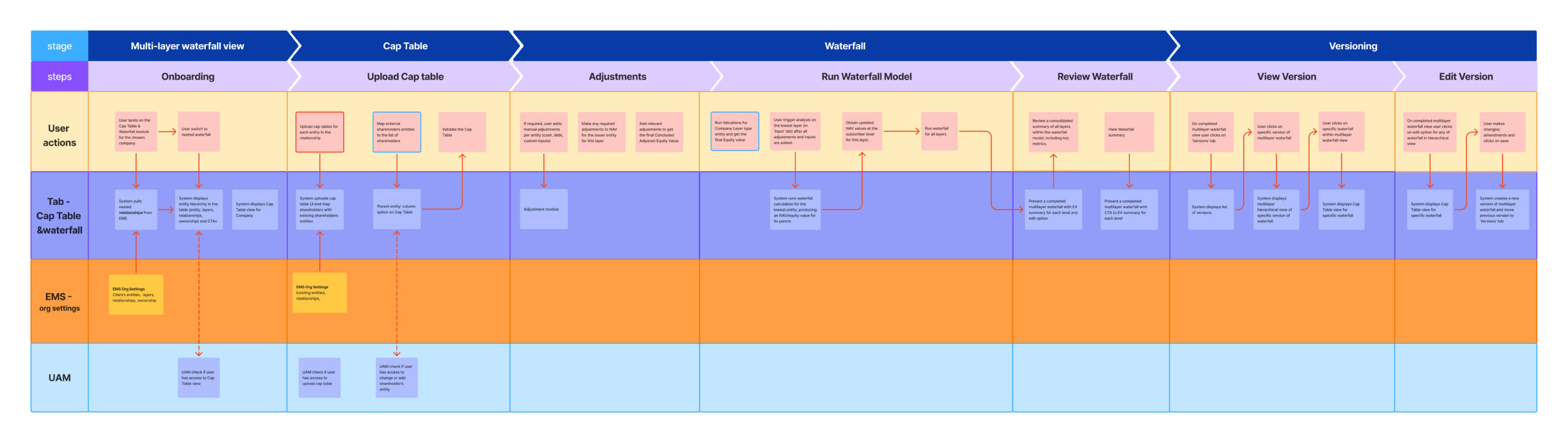
To align the Multi-layer Waterfall with the new Entity Management System (EMS), I started by mapping the real-world investment hierarchy into a clear end-to-end service blueprint. This helped visualise how capital flows between operating companies, funds, funds of funds, GPs, and LPs — and where the existing waterfall logic failed to reflect these relationships.
Working closely with valuation SMEs and users’ insights:
- Mapped EMS parent–child relationships into structured digital flows
- Defined how waterfall execution at one layer impacts dependent layers
- Clarified the order of operations (cap table → waterfall → adjustments → valuation summary)
- Identified decision points and validation requirements across layers
End-to-end service blueprint
Throughout stakeholders workshops, I prioritised:
- Transparency of capital flow and NAV distribution
- Preventing hidden dependencies between layers
- Maintaining user control over adjustments and version changes
- Avoiding overengineering while respecting inherited platform constraints
This approach ensured that the new Multi-layer Waterfall experience aligned technically with the EMS architecture while remaining understandable, navigable, and trustworthy for users managing complex investment structures.
Ideation workshop and POC
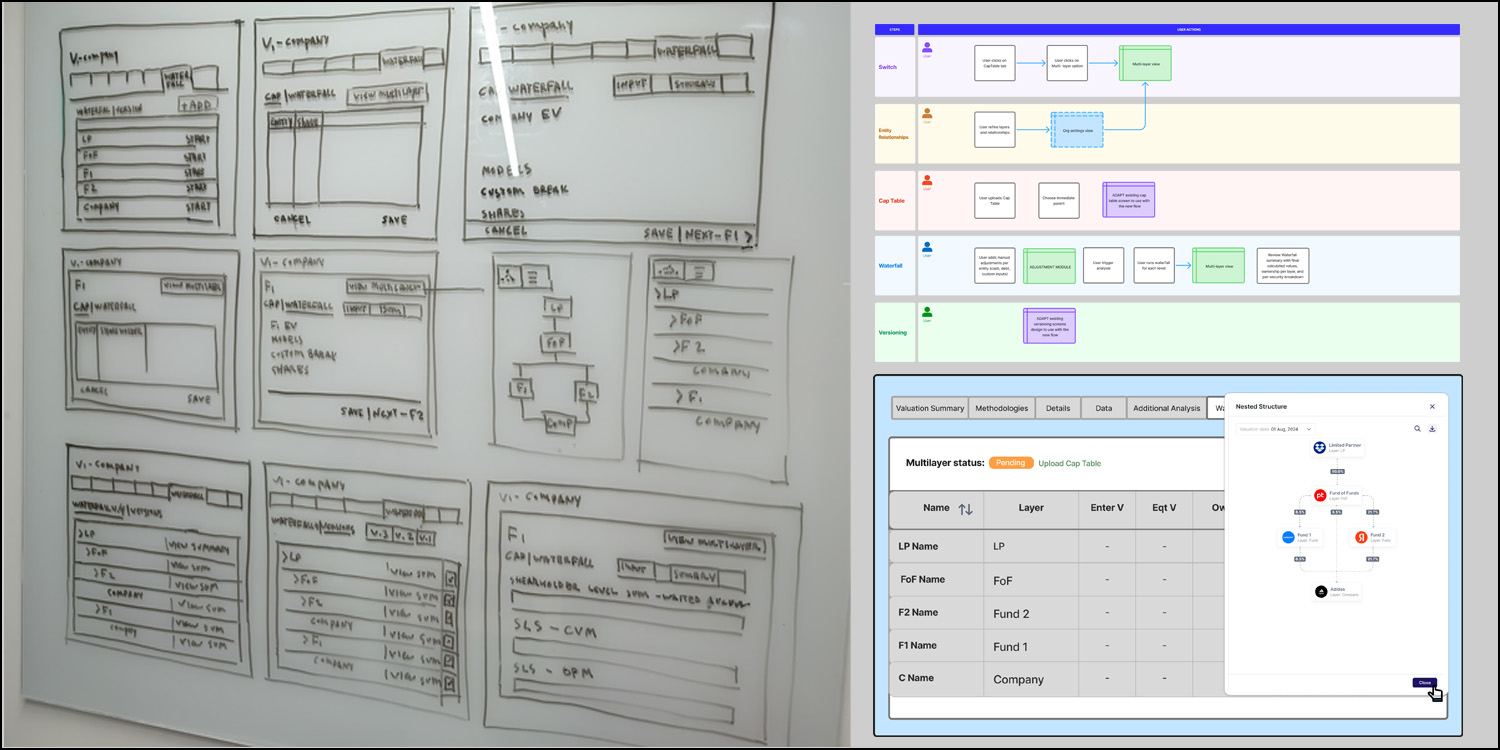
Design
A major focus was making the hierarchy understandable to users. Instead of exposing technical EMS complexity, I translated it into:
- Clear visual hierarchy and structured navigation between layers
- Explicit status indicators (e.g., Ready, Not Started, Requires Attention)
- Transparent versioning logic for cap tables and waterfall outputs
- Clear separation between data updates and calculation steps
I also ensured that interactions were consistent and predictable across entity levels, reducing the mental effort required to move between company-level and fund-level waterfalls.
Wireframes and interactive prototype
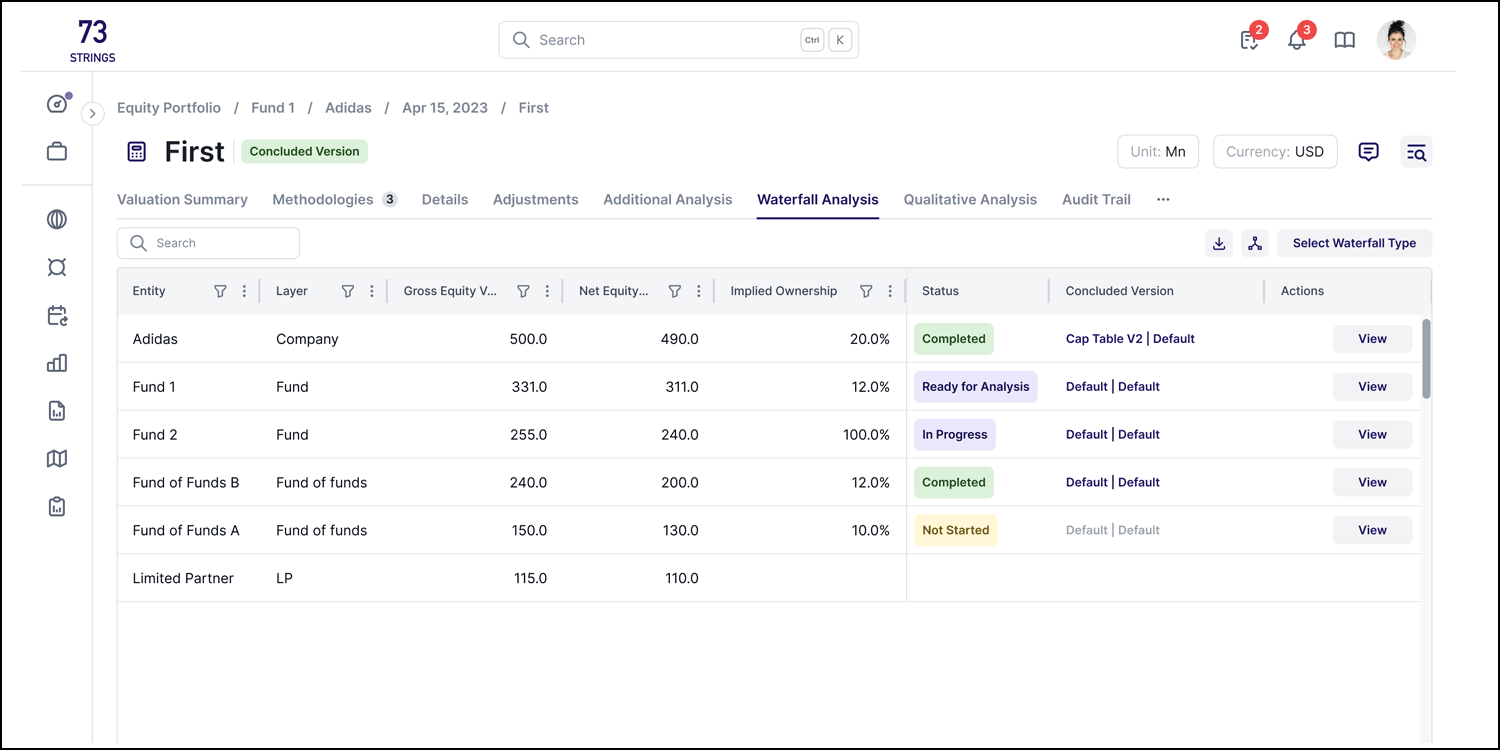
Outcome
The redesigned Multi-layer Waterfall experience successfully aligned the platform with the new EMS hierarchy while maintaining clarity and usability for complex investment structures.
To validate the approach, we conducted a user testing session with a strategic client who actively performs multi-layer waterfall analysis using spreadsheet-based processes. The session involved reviewing real-world scenarios through an interactive prototype and comparing the proposed workflow with their current manual spreadsheet process.
The feedback was highly positive. The client confirmed that:
- The hierarchical structure felt logical and aligned with how they think about entity relationships.
- The separation between layers and visibility of dependencies improved understanding of capital flow.
- Status indicators and versioning logic provided confidence in results and traceability.
- The workflow reduced ambiguity compared to their current spreadsheet process.
Importantly, the session reassured the team that the design direction met real user expectations and addressed practical operational challenges. It validated that we were solving the right problem — not just technically aligning with EMS, but doing so in a way that supported how valuation teams actually work.